
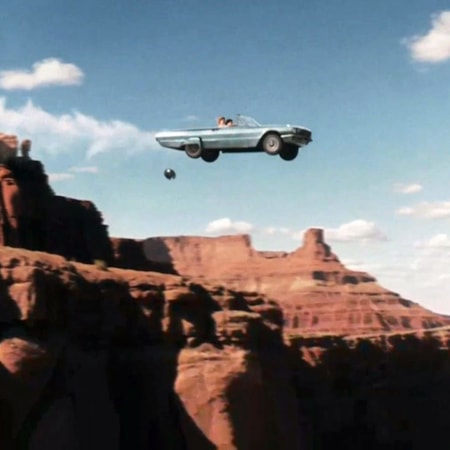




We’ve come a long way since 1991. Women have more rights, more opportunities and more independence. So why are so many of us still asking permission to live our own lives?
I was recently thinking about Thelma & Louise, the iconic 1991 film starring Geena Davis and Susan Sarandon. If you haven’t seen it, firstly, where have you been? Secondly, I thoroughly recommend watching it, particularly if you’re a woman currently in mid-life perimenopause who has spent a significant portion of her life being responsible for absolutely everything.
For those unfamiliar with the story, two friends set off for a weekend away in a convertible. What should have been a fairly uneventful break from their everyday lives turns into a spectacular shitshow involving attempted rape, murder, armed robbery, a very young Brad Pitt and, ultimately, a cataclysmic encounter with the Grand Canyon.
It’s not exactly the relaxing girls’ weekend they had in mind.
When the film was released, it caused quite a stir. Here were two women behaving in ways that had traditionally been reserved for male characters. They were angry, rebellious, sexually adventurous, occasionally reckless and increasingly uninterested in what anybody thought of them. They weren’t particularly concerned about being likeable, which was rather revolutionary in itself.
Thirty-five years later, we’ve made considerable progress in women’s rights and opportunities. Women have more independence, more choices and, in many parts of the world, greater control over their lives than previous generations could have imagined.
But watching the film through a feminist lens in 2026, I found myself wondering how much has actually changed beneath the surface. Because while we’ve made enormous strides in what women are allowed to do, I’m not entirely convinced we’ve made the same progress in what women feel entitled to do.
And I think there’s a rather important difference.
Thelma and Louise: Two Very Different Ways of Being a Woman
At the beginning of the film, Thelma is a housewife married to Darryl, a controlling, dismissive man who treats her rather like a particularly incompetent member of staff. He’s rude, self-important and completely uninterested in her as an individual, except when she’s doing something that inconveniences him.
Thelma has very little autonomy. She manages his moods, accommodates his expectations and has become accustomed to making herself small to keep the peace. Even going away for a weekend with her friend feels like something she needs permission to do, and she ultimately leaves without telling him.
Louise, on the other hand, is fiercely independent. She’s capable, practical, guarded and determined to remain in control of her life. Where Thelma has learned to survive by accommodating other people, Louise has learned to survive by relying on herself.
I find this distinction fascinating because these are two patterns I frequently encounter in my work with women. Some have learned that being loved means being agreeable, helpful and endlessly accommodating. Others have learned that being safe means never depending on anybody, never appearing vulnerable and certainly never allowing someone else to have too much influence over their lives.
Both are understandable responses to our experiences, and both can become rather restrictive ways of living.
Thelma has lost herself in her marriage, while Louise has protected herself so thoroughly that letting anybody close has become difficult. Neither woman is particularly free when the film begins, despite their very different circumstances.
And I suspect most of us can recognise a little of both women in ourselves.
We’ve Given Women More Freedom. Have We Given Them Permission to Use It?
Let’s acknowledge that things really have improved since 1991. Women have greater access to education, employment, financial independence and legal protections in many parts of the world. We can own property, run businesses, pursue careers, choose whether to marry and make decisions about our lives that would have been considerably more difficult for previous generations.
Of course, these freedoms aren’t universal, and even where the laws have changed, access to opportunities remains unequal. But it would be ridiculous to suggest that feminism hasn’t achieved anything substantial.
What interests me is the gap between the freedoms we have and our willingness to exercise them.
You can give a woman all the independence in the world, but if she’s spent her life believing that putting herself first makes her selfish, she may never fully take advantage of it.
I see this regularly. Women who are running successful businesses, managing households, raising children and making important decisions every day, yet feel extraordinarily uncomfortable doing something purely for themselves. They can organise an entire family’s lives without breaking a sweat, but taking an afternoon off to do something they enjoy requires an elaborate justification.
They don’t necessarily need anybody’s permission, but they still feel they ought to ask for it.
A woman in 2026 may not have a husband like Darryl telling her what she can and cannot do, but she may have internalised decades of messages about being a good wife, a good mother, a good daughter and a generally agreeable human being.
And those messages can be remarkably difficult to challenge, particularly when you’ve spent most of your life being rewarded for following them.
The Modern Woman: Congratulations, You Can Now Do Absolutely Everything
One of the great ironies of modern feminism is that women fought for the right to work, earn money, pursue careers and participate more fully in society, only for many of us to end up doing all of that while continuing to carry a disproportionate share of the domestic and emotional labour.
We’ve expanded women’s opportunities without necessarily renegotiating everything that was expected of them in the first place.
So now we have women running businesses, managing careers, raising children, organising households, maintaining relationships, remembering everybody’s birthdays, arranging medical appointments and generally making sure the entire bloody operation continues to function.
And preferably doing it all while remaining attractive, patient, emotionally available and reasonably pleasant to be around.
What a wonderful deal…. NOT.
Obviously, there are plenty of men who are loving, involved and genuinely equal partners. I’m not suggesting that every heterosexual relationship is a hotbed of patriarchal oppression. But the broader pattern of women carrying an unequal share of unpaid domestic work and caregiving remains well documented.
What I find particularly interesting is how easily women can become attached to being the person who holds everything together. Being capable, reliable and indispensable becomes part of our identity, and we may even feel uncomfortable when somebody else takes responsibility.
Sometimes we complain about having to do everything while simultaneously struggling to relinquish control of anything.
And that’s worth exploring, because there can be an enormous difference between being needed and being fulfilled. Being exceptionally good at looking after everybody else doesn’t automatically mean you’re living a life you particularly enjoy.
Why Are Women Still So Uncomfortable With Anger?
One of the many things I love about Thelma & Louise is that the women get properly, gloriously angry. They aren’t politely disappointed or quietly resentful. They’re absolutely furious, and they eventually stop pretending otherwise.
The pivotal moment in the film comes when Louise intervenes to stop Thelma being raped. After the immediate danger has passed, the attacker continues to taunt and degrade them, and Louise shoots him.
It’s a morally complicated act, and one that changes the course of both women’s lives. But the scene also exposes something deeply uncomfortable about women’s experiences of sexual violence: the fear that they won’t be believed, that they’ll somehow be held responsible for what happened, or that the systems supposedly designed to protect them won’t actually do so.
We’ve made enormous progress in discussing consent, sexual assault, coercive control and harassment since 1991. Movements such as #MeToo have helped bring experiences that were once dismissed or silenced into public conversation.
Yet violence against women remains devastatingly common. According to the World Health Organization’s 2025 estimates, approximately 840 million women worldwide have experienced intimate-partner or sexual violence in their lifetime.
So while our understanding and language have evolved, the underlying problem is very much still with us.
But there’s another aspect of women’s anger that interests me, and it’s far more everyday.
Women are often encouraged to be understanding, forgiving and reasonable, sometimes to the point where we become extraordinarily good at explaining away behaviour that hurts us.
I see this in coaching and constellation sessions. A woman will tell me about something that has upset her, and almost immediately begin explaining why the other person behaved that way. Perhaps they had a difficult childhood, they’re under enormous pressure at work, or they’re struggling with their own problems.
And while understanding somebody else’s experience can be valuable, it doesn’t mean your own feelings suddenly become irrelevant.
You can understand why somebody behaves badly and still be angry about how they’ve treated you. Those two things can coexist quite happily.
I think many women have become so accustomed to seeing everybody else’s perspective that they’ve forgotten they’re entitled to have one of their own.
Which brings me to one of my favourite scenes in the film: the truck driver.
After repeatedly enduring his obscene gestures and sexual harassment, Thelma and Louise finally confront him and demand an apology. He refuses, so they blow up his truck.
Now, I’m not advocating the destruction of other people’s property as a healthy way of establishing boundaries, although it would certainly make my coaching sessions rather more interesting.
However, the scene is enormously satisfying because the women finally refuse to quietly tolerate behaviour they’ve been expected to put up with.
Anger isn’t necessarily something that needs to be suppressed, justified or immediately transformed into compassion. Sometimes it’s useful information that tells us a boundary has been crossed, a need has been ignored or something in our lives needs to change.
The challenge is learning to respond to that information constructively rather than allowing it to become destructive.
You don’t need to blow up a truck. But you might need to stop being quite so bloody accommodating.
What Happens When a Woman Stops Trying to Be Good?
Thelma’s transformation throughout the film is fascinating. At the beginning, she’s nervous, dependent and unsure of herself. As the story progresses, she becomes increasingly confident, resourceful and adventurous.
She discovers her sexuality, makes decisions, takes risks and begins to recognise that she’s capable of considerably more than she’s previously given herself credit for.
She also makes some spectacularly poor decisions along the way, which I think is important. Becoming more independent doesn’t automatically make you wise, sensible or immune to manipulation.
Freedom involves learning, and learning sometimes involves making a complete mess of things.
What interests me most about Thelma’s transformation is that she doesn’t become confident because somebody gives her a motivational speech or tells her she’s an empowered woman. She becomes confident because she starts doing things differently.
She makes decisions, experiences the consequences, discovers what she enjoys and begins to recognise her own capabilities.
Her identity changes because her behaviour changes.
And this is something I think we frequently overlook in personal development and healing work.
You can spend years understanding why you behave the way you do. You can identify your people-pleasing tendencies, recognise your attachment patterns, understand your childhood experiences and become exceptionally knowledgeable about the reasons you struggle with certain things.
But if you continue behaving in exactly the same way, your life is unlikely to change very much.
You can understand why you struggle to say no and still agree to things you don’t want to do. You can recognise that you’ve spent your life seeking approval and still make every decision based on what other people might think.
Insight is valuable, but it’s not the same as change.
At some point, you have to start doing something differently, even if it feels uncomfortable, unfamiliar or downright terrifying.
And I think that’s one of the most important things Thelma discovers during her rather disastrous road trip.
The Women Who Came Before Us
This is where the film becomes particularly interesting to me from a family systems perspective.
Neither Thelma nor Louise exists in isolation. Their beliefs about relationships, safety, independence and what it means to be a woman have been shaped by their experiences and the wider social expectations of their time.
And the same is true for all of us.
We inherit far more from our families than physical characteristics and the occasional questionable piece of furniture.
We also absorb beliefs about love, relationships, responsibility, money, success and what constitutes acceptable behaviour.
Think about the women in your own family.
Perhaps your grandmother remained in an unhappy marriage because leaving wasn’t financially or socially possible. Perhaps your mother sacrificed her own ambitions to raise a family. Perhaps the women in your family were praised for being strong, selfless and endlessly capable, while expressing anger or asking for help was considered unacceptable.
Maybe being a good wife meant putting your husband’s needs first, or being a good mother meant having no needs of your own.
These beliefs don’t necessarily have to be explicitly taught. Children are extraordinarily observant, and we learn a great deal about relationships simply by watching the adults around us.
A little girl who watches her mother constantly managing everybody else’s emotions may grow up believing that love means keeping the peace. Another who watches her mother struggle in an unhappy relationship may decide that she’ll never allow herself to depend on anybody.
One becomes a little like Thelma, the other a little like Louise.
And sometimes we become a combination of the two.
Through Family Constellations, I work with people to explore the family patterns, loyalties and expectations that may be influencing how they live today. Often, the beliefs we carry made perfect sense in the circumstances in which they developed, or in the lives of the generations before us.
But circumstances change, and what once helped somebody survive may not be particularly helpful to the next generation.
Not everything we inherit is a burden, of course. Our families also pass down resilience, creativity, courage, resourcefulness and an enormous capacity for love.
The point isn’t to reject everything that came before us. It’s to become more conscious of what we’re carrying, recognise what still serves us and decide what we’re ready to do differently.
You can honour the women who came before you without feeling obliged to repeat their limitations.
The Greatest Love Story in the Film Isn’t Romantic
One of the most beautiful aspects of Thelma & Louise is that the central relationship isn’t romantic. It’s a friendship between two women who genuinely care about each other, even when they’re making a spectacular mess of their lives.
At the beginning, Louise is very much the capable one. She takes charge, makes decisions and looks after Thelma, who initially seems almost incapable of functioning without somebody telling her what to do.
But as Thelma becomes more confident, the relationship begins to change. She starts taking responsibility, making decisions and supporting Louise in return.
Their friendship becomes increasingly equal.
And what I particularly like is that neither woman has to be perfect to remain worthy of the other’s affection. They can be frightened, angry, foolish, vulnerable and courageous, sometimes all within the space of five minutes.
They don’t have to perform a particular version of themselves to maintain the relationship.
I think that’s an enormously important quality in any relationship, whether it’s a friendship, marriage or family connection.
Do the people in your life allow you to grow and change, or is there an unspoken expectation that you’ll continue playing the role you’ve always played?
Sometimes when we begin changing our behaviour, the people around us become uncomfortable. Not necessarily because they’re bad people or deliberately trying to control us, but because relationships develop familiar patterns and everybody becomes accustomed to their particular role.
If you’ve always been the accommodating one, suddenly saying no can create friction. If you’ve always taken responsibility for everything, stepping back may leave other people feeling unsettled.
That doesn’t automatically mean you’re doing something wrong.
Sometimes it simply means the relationship needs to evolve.
And relationships that can accommodate growth, honesty and change are generally far more satisfying than those that depend on everybody remaining exactly as they were.
That Ending: Is It Really Freedom?
And then, of course, there’s the ending.
The police close in, the women are out of options, and rather than surrender, they drive their convertible towards the Grand Canyon. The image freezes before we see the inevitable.
It’s one of the most iconic endings in cinema, and it’s often interpreted as the ultimate feminist act of defiance. Two women choosing freedom rather than submitting to a world determined to control them.
But I find the ending profoundly sad.
Because these women have finally discovered something extraordinary. They’ve discovered aspects of themselves that had been buried beneath years of expectations, fear and accommodation.
They’ve found courage, friendship, excitement, independence and a sense of possibility.
And then they die.
It’s worth remembering that their predicament isn’t simply the result of society punishing independent women. Serious crimes have been committed, other people have been harmed, and their choices have consequences.
But the film also asks us to consider how their experiences, fears and the world around them have contributed to the situation in which they find themselves.
For me, the tragedy isn’t that they choose to drive over the cliff. It’s that they can no longer imagine a future in which they can retain their freedom.
And I think this is where the story becomes particularly relevant to women today.
Because while we may not be facing anything remotely as dramatic as Thelma and Louise, I regularly encounter women who feel trapped in lives they’ve spent years creating.
They have marriages, careers, families, responsibilities and commitments. From the outside, everything looks perfectly respectable, and they may have worked incredibly hard to build what they have.
But somewhere along the way, they’ve lost touch with themselves.
They know something needs to change, but they can’t quite imagine what that change might look like without everything falling apart.
And that’s a horrible place to find yourself.
In 2026, You Don’t Have to Drive Off a Cliff to Change Your Life
Imagine Thelma today.
Perhaps she’s 48, has a career, a home, a family and a marriage that looks perfectly respectable from the outside.
She’s the responsible one. The person who remembers everything, organises everything and makes sure everybody else is okay. She’s spent years doing what was expected of her, and she’s become exceptionally good at it.
She doesn’t necessarily hate her life, but she’s not particularly enjoying it either.
She’s just getting through it.
Then one day, perhaps after a particularly exhausting week, she finds herself wondering whether this is really what she wants the rest of her life to look like.
And perhaps, for the first time, she allows herself to consider that the answer might be no.
Now, this is where I think we need to challenge another popular idea in the personal development world: that changing your life requires some enormous, dramatic reinvention.
It doesn’t.
You don’t necessarily need to leave your husband, abandon your career, sell everything you own or disappear to Bali to find yourself.
Although if Bali appeals, I’m certainly not going to discourage you.
Sometimes meaningful change begins with something considerably less dramatic.
You stop automatically agreeing to things you don’t want to do. You begin noticing where you’re taking responsibility for other people’s emotions. You allow yourself to feel angry without immediately explaining why you shouldn’t.
You start paying attention to what you actually enjoy, rather than what you’ve become accustomed to doing.
You begin making decisions based on your own values and needs, rather than constantly anticipating everybody else’s reactions.
And as you start behaving differently, your experience of yourself begins to change.
Perhaps you’ll decide that your marriage needs to change. Perhaps you’ll decide to leave it. Perhaps you’ll rediscover interests you’ve neglected, make new friends, start a business, return to studying or simply create more space in your life for things that bring you pleasure.
There’s no prescribed outcome.
The point is that you begin participating in your own life more consciously, rather than continuing to follow a script you never realised you were given.
And unlike Thelma and Louise, you have the opportunity to build something different without having to destroy everything that came before it.
The Feminist Revolution Isn’t Finished
Thirty-five years after Thelma & Louise, women have more rights, opportunities and independence than many previous generations could have imagined.
And that’s worth celebrating.
But I think there’s another aspect of freedom that deserves considerably more attention, particularly for women in midlife.
The freedom to stop measuring our worth by how useful we are to other people. To stop believing that being a good woman means being endlessly accommodating. To recognise that having needs, desires and ambitions of our own doesn’t make us selfish.
And perhaps most importantly, the freedom to question the expectations we’ve inherited about who we’re supposed to be.
I don’t believe feminism should be about replacing one set of expectations with another.
A woman who genuinely wants to dedicate herself to raising a family is no less liberated than a woman who chooses not to marry or have children. A woman who enjoys caring for others isn’t somehow failing at feminism, just as a woman who prioritises her career isn’t failing at womanhood.
The important question is whether those choices are genuinely hers, and whether she feels able to make different ones if her circumstances or desires change.
Because there’s a significant difference between choosing to care for other people and believing you have no right to do anything else.
I think that’s ultimately what Thelma & Louise invites us to consider.
What might our lives look like if we stopped organising them around everybody else’s expectations?
What would happen if we allowed ourselves to be a little less agreeable, a little less responsible for everything and a little more interested in what makes us feel alive?
And how much of what we currently believe about ourselves is actually ours, rather than something we’ve inherited or absorbed along the way?
Thelma and Louise had to drive towards the edge of the world to experience freedom.
I’d like to think that in 2026, we have rather more options available to us.
And perhaps we owe it to ourselves, and to the women who came before us, to make the most of them.
You Don’t Have to Blow Up Your Life to Start Living It Differently
If you’ve reached a point where your life looks perfectly fine on paper but something feels missing, I think that’s worth paying attention to.
You don’t need to wait for a crisis, a divorce, a breakdown or some enormous life event before you start questioning whether the way you’re living is actually working for you.
Sometimes the most useful place to begin is by exploring the patterns that have shaped your choices, the expectations you’ve inherited and the ways you’ve learned to relate to yourself and other people.
This is the work I do through Life Coaching and Family Constellations.
We explore what’s keeping you stuck, where those patterns may have originated and what needs to change so you can begin living in a way that feels more authentic and fulfilling.
And we don’t stop at understanding the problem. I’m particularly interested in what happens afterwards, when you take those insights and begin putting them into practice in your everyday life.
Because there’s very little point having a wonderful revelation about why you’ve spent your life accommodating everybody else if you go straight back to doing exactly the same thing.
You don’t have to drive off a cliff, blow up a truck or run away to Mexico.
But you might have to start making some different decisions.
Your life. Your next chapter. Your way.
Explore working with me or book a discovery call HERE to find out where we might begin.


+ show Comments
- Hide Comments
add a comment